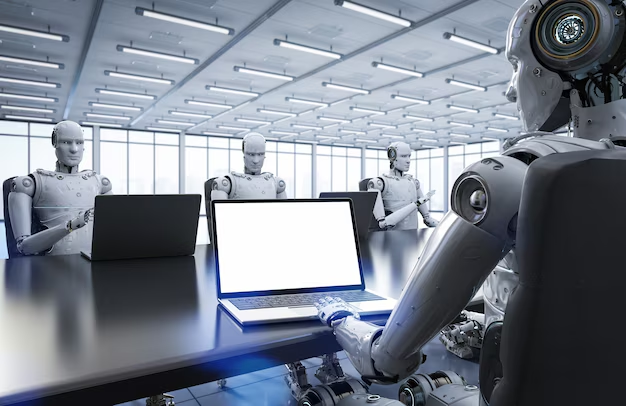
Last week we performed the thankless task of revealing which jobs and industries will be impacted most severely by Artificial Intelligence. The research was sobering. Half way through the article I started thinking about perhaps another topic to write about, but it is time for all of us to learn which career paths are vulnerable and which paths are resistant to AI. While the landscape of the job market is undoubtedly shifting, a closer look reveals that roles requiring uniquely human attributes such as emotional intelligence, creativity, critical thinking, problem solving and complex social interaction – are becoming increasingly valuable.
AI thrives on data, patterns, and logic. It is already processing vast amounts of information, automating routine procedures, and even generating plausible content. However, it fundamentally lacks consciousness, genuine empathy, and the ability to navigate the unpredictable nature of human experience.
Here’s a breakdown of careers resistant to AI:
- Healthcare Professionals:
Healthcare roles require a human connection, empathy, and decision-making, making them highly resistant to full automation. AI simply cannot replace the fundamental human element.
- Doctors, Nurses, and Therapists: While AI can assist with diagnostics, it cannot provide a bedside manner, win the trust of patients, or adapt to the physical and emotional needs of an individual in real-time. The U.S. Career Institute lists growing paths in healthcare: Here are the top 4 paths within healthcare with the lowest risk of automation.
- Nurse Practitioners (projected growth 45.7%)
- Physician Assistants (27.6%)
- Mental Health Counselors (22.1%)
- Physical Therapists (13.9%)
The US Career Institute also lists the following healthcare careers as AI resistant.
- Psychologists and Counselors: How can you provide mental health without building rapport, understanding subtle emotional cues, and providing personalized, empathetic guidance?
- Occupational Therapists and Physical Therapists: These roles require real-time hands on adaptation to a patient’s physicality and progress, as well as the ability to connect on a personal level. As noted, Occupational Therapists are projected to grow by 13.9% by 2032, highlighting their continued human necessity.
Creative Professions: Where Originality and Emotion Reign
I am sure AI builders will debate this because generative AI can produce impressive art, music, and writing, but true creativity rooted in human emotional depth and experience remains distinct.
- Artists, Musicians, and Performers: AI can generate endless variations of existing styles, but as a lead guitarist with 45 years of experience, I can tell you the playing I have heard lacks the emotional pain and joy that fuels genuine artistic expression. Studies like those from “It’s Nice That” show only 1% of creatives believe AI-assisted work reaches the highest aesthetic standards currently.
The deep connection an audience feels with a human performer is also irreplaceable. Choreographers, for example, show a robust projected growth of 29.7% by 2032.
- Writers, Poets, and Storytellers: We know AI can draft articles and marketing copy, but weaving compelling narratives, evoking complex emotions, and imbuing content with human insight and originality remains a human strength.
- Creative Directors and Brand Strategists: These roles require the capacity to inspire and guide human teams.
- Trades and Skilled Labor: The Physical and Problem-Solving Edge
Jobs requiring physical coordination, on-the-spot problem-solving in unpredictable environments, and direct physical interaction are highly AI-resistant. Here are some examples:
- Electricians, Plumbers, Carpenters, and Mechanics: We all have trouble finding any of these workers because the demand is so high. Based on our research, I don’t see this changing. These roles involve diagnosing problems in varied physical spaces, requiring intricate repairs, and adaptive problem-solving that current robots cannot replicate.
While statistics on AI’s impact on the trades are still evolving, CBS News highlights that the acceleration of AI could push more young people into skilled trades that don’t require a high-priced college education, suggesting their continued demand.
- Construction Workers: The reliance on human judgment in handling heavy machinery and complex materials makes these jobs nearly impossible to automate.
- Hairdressers, Barbers, and Beauty Therapists: The physical touch and deep understanding of individual preferences are, thankfully, beyond AI.
- Educators and Mentors: Nurturing Human Potential
Teaching and mentorship involve inspiring, guiding, and adapting to the unique learning styles and emotional needs of individuals.
- Teachers and Professors: While AI can personalize learning materials and automate grading, it cannot replicate encouragement, mentorship and social-emotional development. Despite AI adoption in education, a 2023 Tyton Partners survey found that only 9% of instructors were regular users of generative AI tools, indicating the human role remains central.
Nursing Instructors and Teachers (Post-Secondary) are projected to grow by 21.5% by 2032.
- Coaches (Sports, Life, Business): Coaching relies on understanding motivations, fostering growth, and building strong relationships. Coaches and Scouts are projected for a 20% growth by 2032. The human element of inspiration and accountability is paramount and irreplaceable.
- Leaders, Strategists, and Innovators: The Visionary Roles
At the highest levels, jobs that involve strategic vision, ethical decision-making, and inspiring complex human teams remain firmly in human hands.
- CEOs and Business Leaders: Leadership is about vision, ethical judgment, motivating people, navigating ambiguity, and making high-stakes decisions with imperfect information. While AI in leadership development has seen an increase in experimentation (from 23% in 2024 to 35% in 2025), the top leadership skills of coaching and communication remain fundamentally human. McKinsey’s research shows that even as organizations deploy AI, they are redesigning workflows and putting senior leaders in critical roles, such as overseeing AI governance.
- Ethical AI Consultants/Policy Analysts: Let’s not forget the rise of AI creates new roles inherently resistant to AI itself. These roles ensure AI systems are transparent and don’t perpetuate biases, requiring direct human oversight. The Times of India identifies “AI ethics specialist” and “AI policy analyst” as emerging non-tech career paths in AI, requiring backgrounds in philosophy, sociology, law, and public policy.
- Scientists and Researchers: While AI can analyze data, the initial creative leap of formulating hypotheses, designing experiments, and interpreting unexpected results with human insight is still a human endeavor. Physicists, for instance, are projected for an 8.2% growth by 2032.
The Path Forward: Human-AI Collaboration
The most resilient and valuable jobs will be those where humans leverage AI as a powerful tool to enhance their uniquely human capabilities. The World Economic Forum’s Future of Jobs Report highlights that human skills like critical thinking and creative problem-solving are increasingly essential.
In the future, developing the capacity for continuous learning and adaptation will be far more important than clinging to tasks that can be easily automated. The jobs that are truly safe from AI are those that embrace and champion the irreplaceable essence of being human.
Are you having difficulty finding talented employees to fill your open positions? With 25 years of experience, a 4.8 Google rating, an average experience level of 22 years, our own Thought Leadership Team, and an A+ rating from the BBB, you will quickly see why we’ve built so many permanent, long-term client relationships. Visit our website at www.execsallied.com/employers or Email us at info@execsallied.com. We are here to help!